Farming in the City: Variances Approved

In the springtime


We are very happy to report that all of our variance applications were approved on Tuesday by the city zoning board! This is a huge step in our efforts toward trying to save this family farm property. The meeting proceedings even made it into the local news, in the Lockport Union Sun & Journal and the Buffalo News.

The Process

We found out last month that the whole 100-acre property, that has always been farmland, was zoned residential. In order to operate it as a farm, we needed to apply for variances for land use, retail to sell in the barn, some signs and a place for people to park. Notices were sent to all our neighbors. Well, since we are located in a city, that totaled about 60 residences around the perimeter of the property. The process included a zoning board meeting that is open to the public. About 40 people attended and were able to hear our proposed plans and voice their concerns and opinions. We were able to address them with further clarifications. In the end, the board passed each of the variances unanimously.

Next, the plans go through the County Planning Board for recommendations. This is because our property line touches the town border. After that, they will go through the City Planning Board. These address more technical issues, such as size of the parking lot. For this, we will have to hire a landscape architect because all the plans need to be drawn up to scale.

This was an unexpected process to do this Spring. But, just like healthy soil for plants, we realized that it is a necessary step to make sure our farm business is on a solid foundation. Fortunately, the process has been well laid out and people have been very helpful, even though it is uncommon for the city to see this kind of business start up. We’ve come to find out that it is not all that uncommon anymore. More and more farms are being tilled in private and vacant lots in cities around the country.

Barn & sheds, view from the yard

We’re Not Alone

To prepare for the meeting and for our own knowledge, we reached out to friends who knew about the urban agriculture movement and to pretty much anyone who might be able to provide information or share experiences. We got a lot of responses. A school friend active in Louisville’s local food movement was even willing to help go through ordinances with us. It is not just farmer’s markets anymore. People are moving the farming right into the cities.

We were surprised and thrilled with what is occurring across the country. In February, the Boston mayor kicked off a zoning process to encourage community farming, as it beautifies the city and widens access to fresh, healthy food to people who can’t usually get it. In 2010, Cleveland passed a very progressive recoding policy to make it as easy as possible to start farming in the city limits because it attracts and keeps residents. One of Milwaukee’s two booming urban farms, Growing Power, is hosting the 2012 Urban & Small Farm Conference: Growing the Good Food Revolution. In Buffalo, there are four gardens/farms that we learned of who are growing fresh produce within the city limits: Wilson Street Urban Farm, Queen City Farm, and Cold Spring Coop, and the Massachusetts Avenue Project aquaponics project. Right here in Lockport, Hall Apple Farm is a historic farm that is in both Lockport the city and the town.

So far, we have mostly thought of our efforts as preserving this special house and property that has somehow remained intact and in the family by making it our home and restarting the farm. This week, we realized how much bigger it is than just our little corner. It is connected to the neighborhood, the city, and even to a trend that is taking a many people back to their roots and to the roots. We may have many more meetings to attend and rows to hoe, but we are more committed to offering fresh locally grown produce from our barn doors. Thank you to all those who have encouraged us along the way.

Sunset over the fence

Quick Fixes #2

Before: A jumble of mossy rocks


In several places on the property, it is obvious that something used to be there. Mounds of cut stones lie where buildings and walls used to stand. Broken glass, ceramics and coal mark old dump sites. Raised ground is remnant of long forgotten roads. Ditches reveal old wells and broken clay drainage tile. Nothing excites me more, as a one-time archaeologist, than a little exploring to dig up the past. For safety and the protection of expensive farm equipment, it is also good to know where these piles and holes are located and what lies beneath.


We have matched some rubble piles to historic photos and maps, but others are a mystery. A jumble of rocks in front of the barn had me baffled. So, I took a shovel to it. I discovered a 15×4 foot retaining wall. Years of erosion and tree growth had toppled and covered it. Being in a fix-it mood, and highly caffeinated that morning, I decided to rebuild it with the help of my brother-in-law.


It was much easier than rebuilding the old fieldstone wall that we fixed earlier in the year. At least these stones were in some kind of order. The key to rebuilding a retaining wall without mortar is to have a solid foundation and to lean the wall slightly back against the higher ground for strength. We pulled out the stones, staked out the area and evened out the foundation. Then, we stacked layers of interlocking flat stones row by row. Last, we packed the soil down behind it. My wife even planted some spring daffodils around. Good as new!

Gradually restoring the farm to how it used to be is challenging, but also a lot of fun. When we don’t have old photos to go by, we’re stuck with reasoning things out. What was this pile of rocks? What had that been? Sometimes, it is just a pile of rocks. But sometimes it is another trace of the farm’s long history.

After: A great-looking retaining wall!

Quick Fixes #1

This 180-year-old house underwent major renovations in the 1930’s and 1950’s. Probably the biggest fundamental shift to the house (well, besides indoor plumbing and electricity) was when they moved the driveway from the front of the house to the back. Horses and carriages used to ride up a semi-circle arc on the south lawn. But, after cars were invented, they moved the driveway to the back of the house, on the north. The problem with a north-facing entrance is that it is always damp. Over 80 years of constant moisture on the stones created a thick coating of slippery brown moss and algae that made that side of the house perilous and ugly. It was the perfect excuse to break out the power washer!

Like a dentist with a super-charged water pick, I blasted every nook and cranny, peeling layers of slime off the stones. Three hours and two soaking feet later, the walkways in the front were clean and several shades lighter. This also allowed the ornate stonework on the facades to stand out once again.
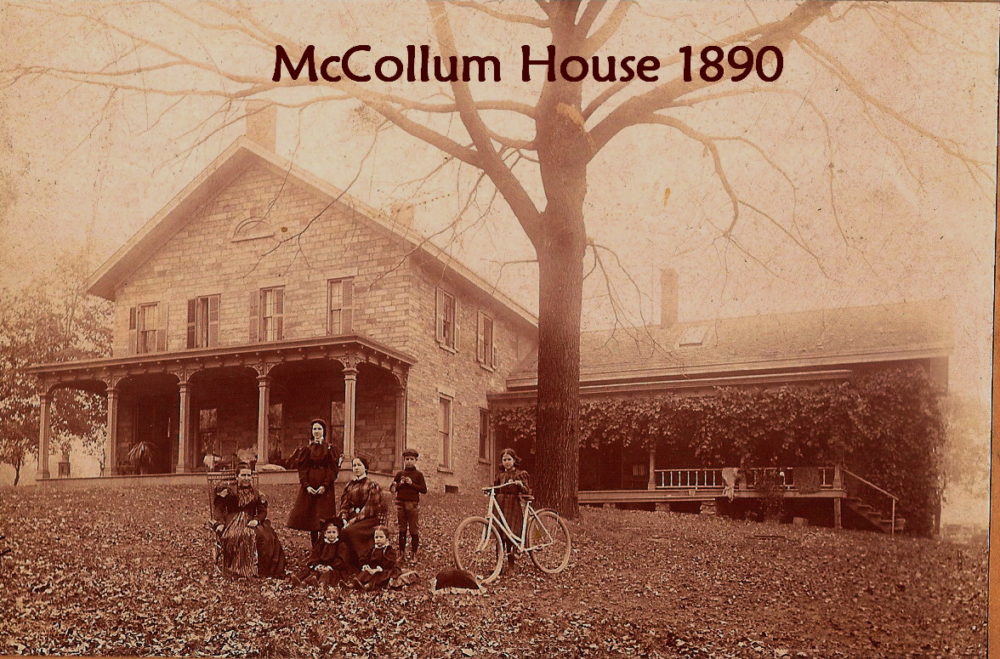
Continuing with “quick fixes” like these has made the biggest difference for me personally, in terms of turning the look and feel of the property back into a lived-in home. Of course, the minute we cross one off the list, another one goes on it. So, there are many more to come. But, we’re getting there!

Flash Back – Cobwebs in the Attic

A dusty box of papers in the attic revealed some amazing insights about life on this family farm back in the late 1800’s. For years, dozens of post-Civil War Era receipts and contracts from my great-great-grandfather, Silas Wright McCollum, and local businesses sat collecting cobwebs. It wasn’t until our “Big Clean” that some of these documents came to light. They give us a rare glimpse at the business of the historic farm. They also paint a vivid picture of this bustling town on the banks of the Erie Canal.

An invoice for seeds dated February 1883 from James Vick (of Rochester, NY) show what my family planned to plant and sell that year. It also gives a hint at what grew best on the farm and what produce was in highest demand during that time. Beans, peas, potatoes, cabbages and onions were among the many vegetables ordered. Near the bottom, you’ll see an order for a plant called Salsify, an oyster-flavored root vegetable. I guess our tastes have changed.
With the farm being situated next to the Erie Canal and a railway, it is possible this produce was shipped out West, along the Atlantic Seaboard and even out of the county.


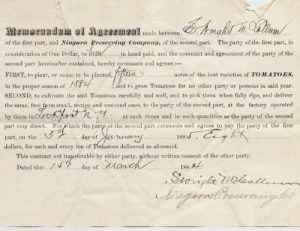
A Memorandum of Agreement dated March 1884 was signed between my great-great-grandfather and the Niagara Preserving Company. In this, S. W. McCollum agreed to plant fifteen acres of “the best variety of tomatoes” and sell them only to the Niagara Preserving Company in exchange for a pre-negotiated selling price of $8 dollars per ton.

Besides needing to feed his own family, Silas also had to feed his workers and care for a wide range of farm animals. This bill from Arnold & Little, merchants from a Lockport city mill, shows a balance of $180.89 for the purchases of flour, feed & grain between October 1883 and March 1884.


Just like today, advertising your products and services is a key part of doing business. At a time before radio, television and the internet, printed word was your best option to reach the masses. In this receipt from October, 1884, Silas paid $23.50 in advertising expenses to the Union Printing and Publishing Co., owners of the Lockport Daily Union and the Niagara Democrat, the “best advertising mediums in Western New York.” In that spirit, we want to say, “Silas, welcome to Google.”

Rebuilding the Past

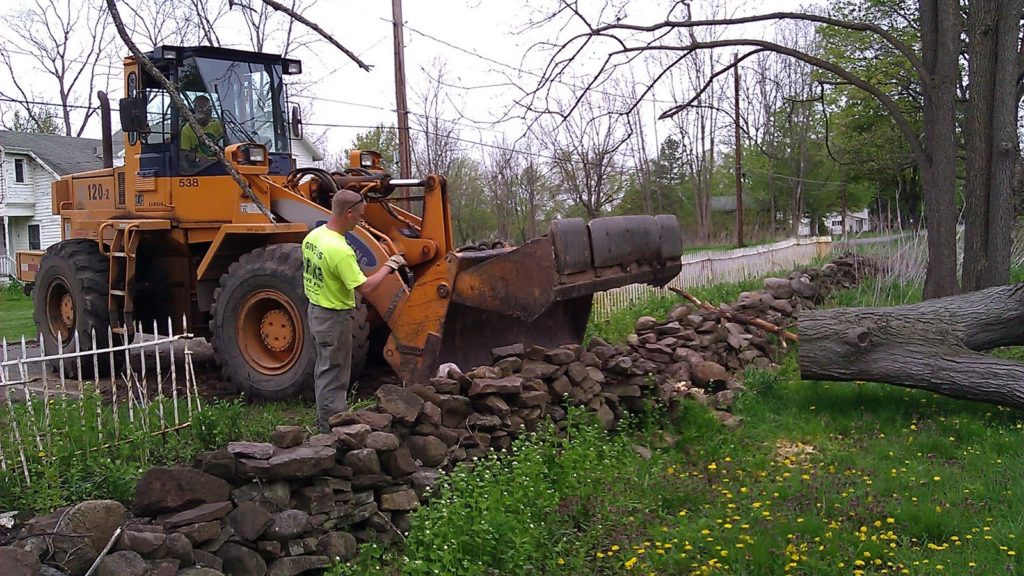
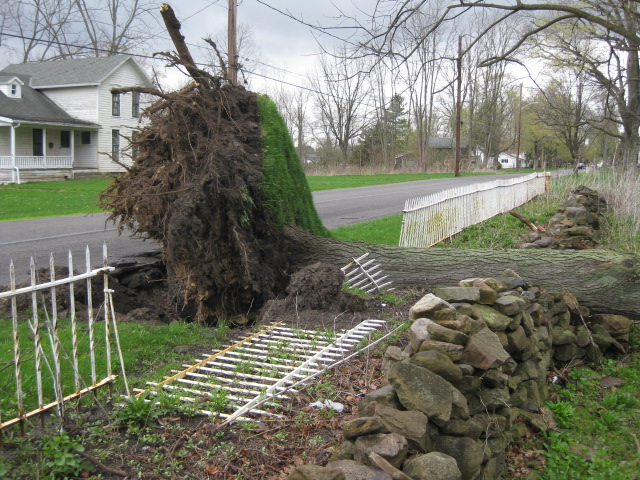
Back in April we wrote about a powerful freak windstorm hit Lockport, NY with wind speeds recorded at 83 mph. Dozens of trees fell, knocking down power lines and blocking traffic. The most notable casualty was a grand century-old Locust tree that shaded our quiet neighborhood street. When it fell, it left an 8-foot deep crater in the road. It also crushed an old iron fence and a section of a historic fieldstone wall that my ancestors built back in the 1830’s.

The fallen tree lay there for a few weeks (during which neighbors and passerby stopped to take photos) until the City hauled it away. The crew had to bulldoze a wider span of the old stone wall to drag it off our property. Just what I needed: another project.

Back in the day, horse- and ox-drawn plows crisscrossed the farm, tilling the ground. Rocks that were plowed up were carted to the sides of the fields where they were used to build stone walls that marked plots and property lines. Several generations of farming had produced a sizable wall of stacked rock. It stretches through the fields, in neighbors’ yards and even pops up on the other side of the street.

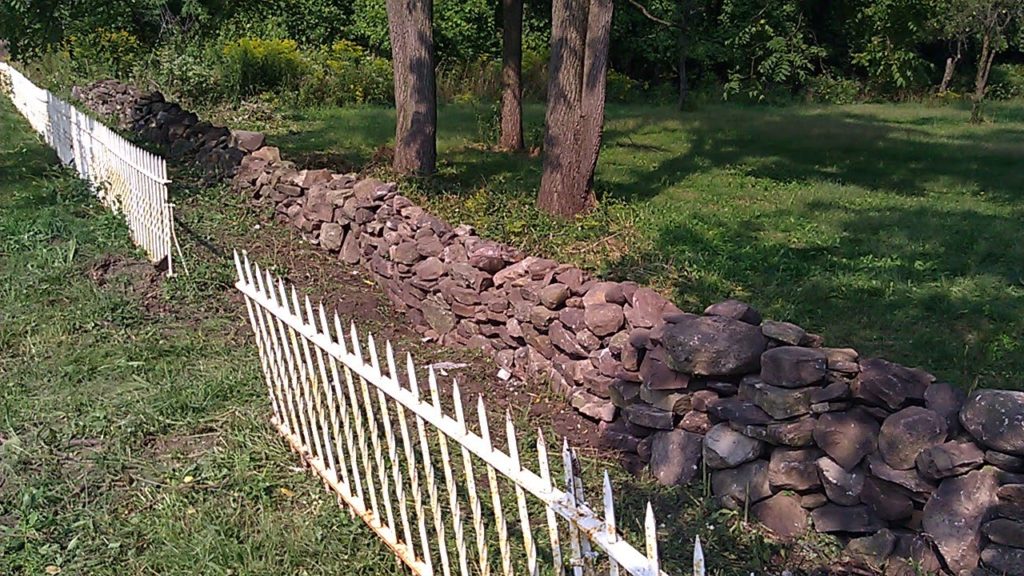
Project Rebuild waited until the end of the summer, after planting and the weather cooled off and when my brother-in-law, a former Russian body-builder, happened to be visiting. The first step was actually to clear the jumble of rocks and dismantle more wall so I could see how it was originally constructed. It brought me back to my days working as an archaeologist.

It was a double-wall construction, where two lines of large flat-faced rocks were placed on either side, and small rocks were piled in the middle trough. Thin stones where then used as shims to stabilize the layers. This back-breaking process was repeated until the wall was about 4.5 feet high, then a large capstone was set on top to hold everything in place.


Putting the wall back together was like finishing a large, very heavy jigsaw puzzle. The biggest boulders weighed over 300 pounds. And we have no oxen. It took pick axes, pry bars, perseverance and a lot of brute strength. But, we repaired the wall. Then, we even moved on to rebuild some other sections that had crumbled and collapsed over the decades. When we were finally finished, we’d added 20 feet of new wall with stones that we had collected during this growing season.

Repairing that wall made me appreciate the amount of labor that went into building this farm over the generations. It’s the kind of work that has to be done by hand. Sure, a machine could move the rocks, but only a person can construct that complex wall. Rebuilding the wall was like rebuilding a connection to my ancestors who did the same project on the same spot 180 years ago.


Next time you drive through the countryside and see an old stone wall in the woods, take a second to think of the family who toiled in the fields and built that wall in their attempt to clear the land and make a life for themselves. Until the day comes when no more stones surface in the fields, the wall on our property will be, as it’s always been, a work in progress.